China Cancels Solar Panel Export Rebate from April 1, 2026 — Reshaping the Global PV Trade Landscape
Source: China Chamber of Commerce for Import/Export of Mechanical & Electrical Products | March 2026
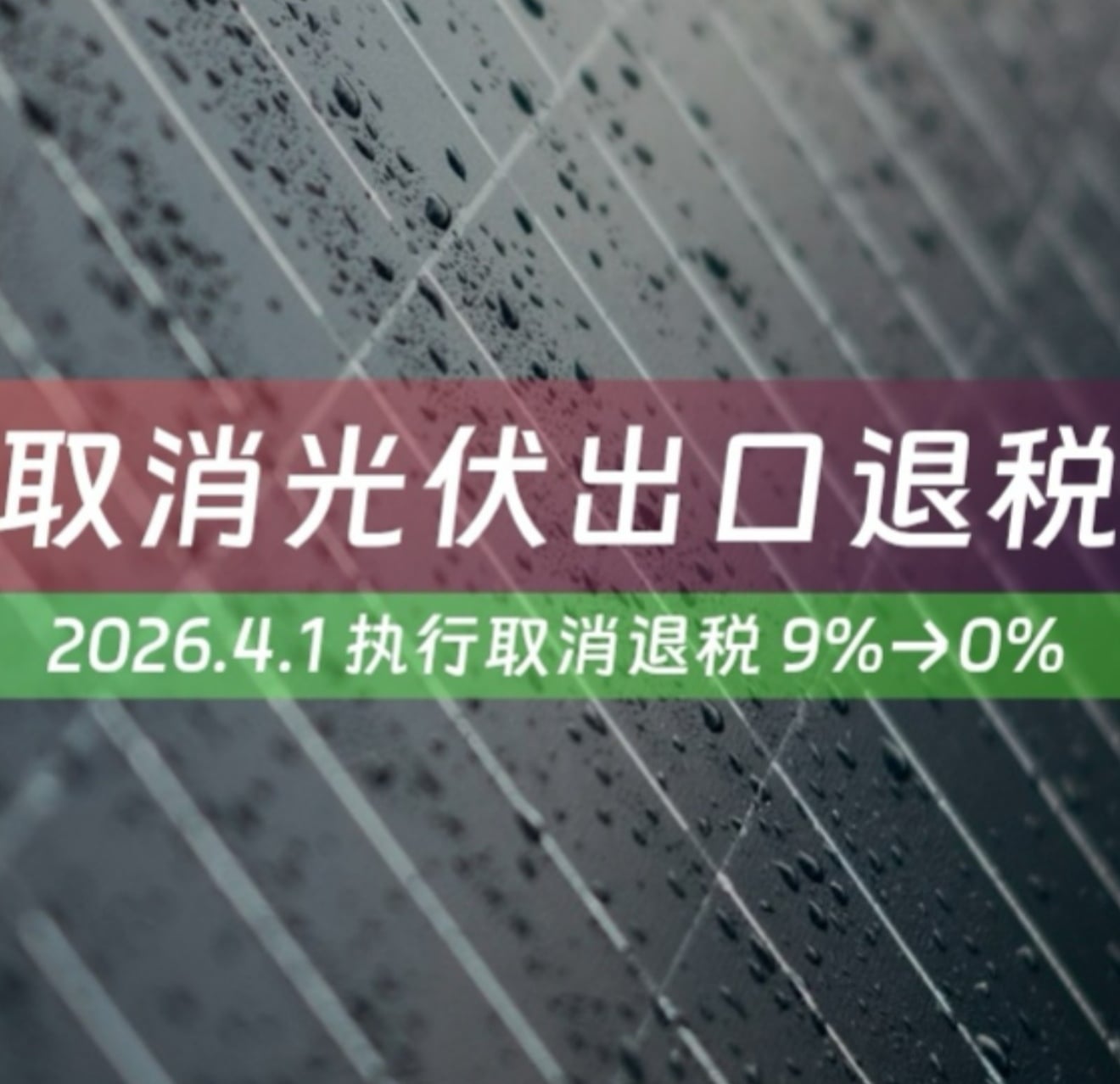
| 0% Export Tax Rebate from April 1, 2026 | 12 Years Era of PV Export Rebate Now Ended | 70%+ China's Global PV Market Share | $0.08/W Lowest Module Price Reached in 2025 |
By end-2025, China's Ministry of Finance and State Administration of Taxation jointly announced a major policy shift: the export tax rebate for solar cell products would be reduced from 9% to 6%, and fully cancelled from April 1, 2026. This marks the official end of the 12-year era of PV export rebates — and will profoundly reshape how China's solar industry competes globally.
1. Policy Rationale: From "Blood Transfusion" to Self-Sustaining Growth
China's export tax rebate policy for solar started in 2013, when the industry had just survived anti-dumping investigations from the EU and US. The generous 13% rebate served as critical support — helping Chinese PV products conquer global markets with highly competitive pricing.
But success created new problems. As the industry matured, export rebates became fuel for a destructive race to the bottom. Companies converted rebates into discounts for overseas buyers — effectively subsidizing foreign customers. Module prices fell to around $0.08/W at one point, making it nearly impossible to cover operating costs. From January–October 2025, PV export value declined 13.2% year-on-year despite volume growth.
| Phase | Rebate Rate | Industry Context |
| 2013–2024 | 13% | Recovery from EU/US anti-dumping investigations; market expansion phase |
| Late 2025 | 9% → 6% | Gradual phase-down announced; industry repositioning begins |
| April 1, 2026 | 0% | Full cancellation — industry competes on technology and brand |
2. Short-Term Shocks: Costs, Rush Orders, and Overseas Pressure
The immediate impacts were swift. Export costs for each 210mm module increased by an estimated 46–51 RMB. Gross export margins face further compression in an already thin-margin environment.
To capture the last window of rebate benefit before April 1st, Chinese manufacturers cancelled Spring Festival holidays and ran full-capacity production schedules. Logistics teams prepared for a surge in pre-deadline shipments.
Overseas markets also felt the pressure. In countries like Greece — where solar project IRRs were already below 6% — the rebate cancellation directly challenged investment viability. India, whose local cell production covers only 30% of demand, faced a 14–18% increase in module costs, threatening its 500GW non-fossil energy target.
3. Long-Term Transformation: From Price Wars to Technology Leadership
The China Solar Industry Association frames the policy as a catalyst for healthy market restructuring. Companies that survived purely on price subsidies will exit. Top-tier manufacturers with genuine technology, scale, and brand advantages will increase market concentration.
The competitive battleground is shifting from unit price to technology and brand value. Next-generation technologies — HJT, perovskite, and heterojunction bifacial — will become the real differentiators. Enterprises building global manufacturing footprints and brand equity are best positioned for the new era.
"Cancelling tax refunds is not the end point, but a new starting point for the upgrading of China's solar industry. In the past, Chinese solar companies relied on low prices to increase production — in the future, they will rely on technology and brands to establish themselves in the global market."
— PWSOLAR, March 2026
4. What This Means for Solar Buyers in 2026 and Beyond
For project developers and distributors sourcing Chinese PV modules, the policy shift has two implications:
-
Short-term price adjustment: Expect module prices to stabilize or slightly increase post-April 2026 as the artificial floor of subsidy-driven pricing corrects.
-
Supplier quality shift: Surviving manufacturers will be genuinely competitive — better R&D, better quality control, stronger warranty backing.
Since 2026, PWSOLAR has increased its presence in emerging markets through content marketing on TikTok, LinkedIn, and regional channels — driving 50%+ year-on-year order growth in emerging markets despite the overall policy headwind.
Source Your Modules from a Manufacturer Built for the New Era
PWSOLAR's competitive advantage is technology and reliability — not rebate arbitrage
Browse All PWSOLAR Products →
Get Ahead of Market Changes — Lock In Your 2026 Supply with PWSOLAR
As the PV industry resets after the rebate era, PWSOLAR's strength is built on technology — not subsidies. Contact us to discuss pricing, specifications, and long-term supply agreements.
✅ Up to 24.02% module efficiency — genuine technology advantage
✅ CE, IEC, UL certified for global market compliance
✅ 30-year linear power warranty
✅ OEM/ODM available for distributors and EPC contractors
Get a Quote from PWSOLAR →

 EN
EN